
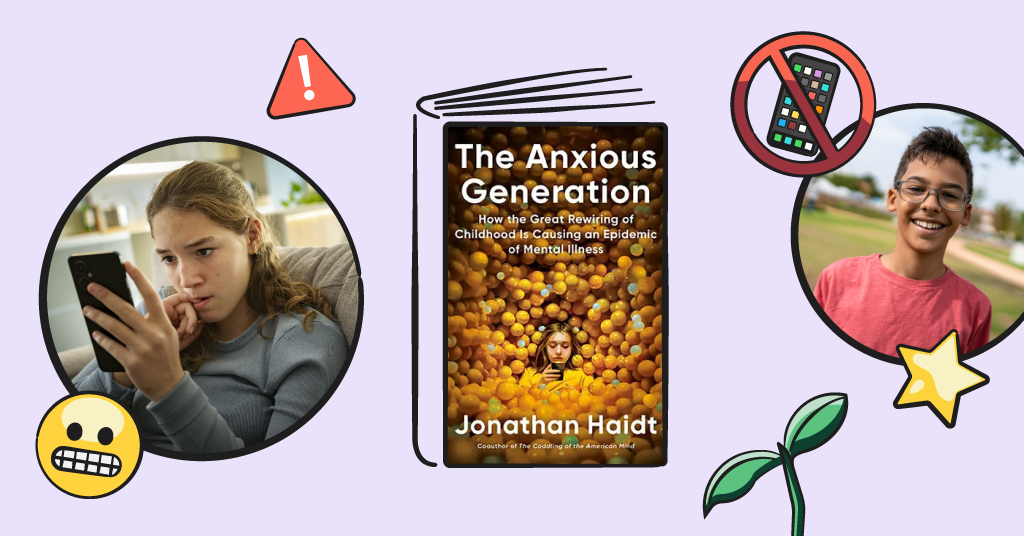
Here at Bark, we’re huge fans of Jonathan Haidt’s best-selling book The Anxious Generation: How the Great Rewiring of Childhood Is Causing Mental Illness. Published in 2024, it’s garnered incredible praise from top publications, and it’s easy to see why. He lays out a measured, researched approach to the mental health crisis facing kids today, and ties it to the advent of phone-based childhoods. We’re big believers that every parent should read this eye-opening piece of work, as it can help you change the way you approach parenting in the digital age.
To give you an idea of just how incredible it is, we’ve pulled together five salient points that help illustrate why major change is needed in the modern age when it comes to raising kids.
5 Takeaways from Jonathan Haidt’s The Anxious Generation We Can’t Stop Thinking About
1. Parents should supervise their kids less in the real world and more when they’re online
One of the key arguments that Haidt makes in his book is that starting with Gen Z, parents shifted their attention to removing any element of potentially dangerous situations from their children’s worlds. No longer were kids playing outside until the streetlights came on or wandering around the neighborhood. So obsessed were parents with the idea of strange men in vans kidnapping tweens that they eliminated nearly all aspects of free play outside.
Ironically, though, this same generation of kids — while strictly supervised and housebound more than prior generations — were freely given smart devices where predators actually were spending time and targeting kids. Part of this, of course, was based on insufficient knowledge. At the time, we didn’t realize just how risky screen-based childhoods would become. Social media came on quickly, with platforms constantly changing and adding features, many of which were harmful.
Basically, kids need more IRL free play to learn how to handle themselves, make friends, and develop social skills. And when they are on devices, that use should be limited and heavily supervised by their parents.
2. Social media harms the social lives of teens who don’t even use it.
The addictive nature of social media and smartphones is a given. And while yes, parents can put their foot down and prevent their kids from creating accounts, that doesn’t really help the problem until every parent takes the same stance. Haidt cites a study that showed kids with phones at school talked less between classes, at lunch, and during recess. This results in less eye contact, less laughing, and generally less social interaction, all of which also affects the kids who don’t have phones.
This eye-opening illustration is further proof that we’re not just raising our kids in a bubble — everything we do affects everyone else. That’s just how insidious social media can be in the lives of tweens and teens.
3. Gen Z is less able than any other generation in history to put down roots in real-world communities populated by known individuals who will still be there a year later.
This description sounds formal, but it’s describing a way of living that our ancestors would never have recognized. With the advent of online lives, social media obsession, and tech addiction, humans have traded in real-time bonding for anonymous, asynchronous, and largely shallow interactions.
It’s no wonder that Gen Z is experiencing record levels of isolation, anxiety, and depression. For communities to work, people need to be invested in their homes, communities, and each other. Screens and social media relationships don’t replace in-person interactions or the hugely positive effects they can have on humans.
4. Social media companies see the loss of market share among users as an existential threat and have considered how to reach kids as young as 4.
Everyone thinks that social media platforms are free to use, but the reality is that we pay with our time and attention. Adults have the context and maturity to understand (most) of what they see online, but kids are different. Their little brains are still developing, so social media and its addictive nature present dangers that many parents may not be aware of.
But you know who is aware of the dangers? Social media companies. And that’s why it’s wild that they’ve taken a page of the Big Tobacco playbook and have studied how to attract kids at younger and younger ages. If you can hook someone early, you can hook them for life. This guarantees ad revenue and market share, but the collateral damage can affect a child’s mental health for years.
5. Some teenage girls spend 20+ hours a week on social media, and though the work is often joyless, they still feel compelled to do it.
This stat is from 2014, but it’s clear that many girls in 2025 are still engaging in this sort of behavior. It’s heartbreaking because if no one is getting joy out of screen-based childhoods, why are we still allowing them to happen? Social media, especially for girls, introduces a ton of stress into their lives, with comparison culture, exposure to disordered eating content, and the pressure to “perform” online 24/7. Kids shouldn’t have to work the equivalent of a part-time job to maintain “their brand.” They should be playing outside with friends and exploring, wandering, and having fun.
How Bark Can Help
In The Anxious Generation, Haidt lays out four new norms that parents everywhere should adopt:
- No smartphones before high school
- No social media accounts before 16
- Phone-free schools
- More independence and free play for kids in the real world
He’s absolutely right on track, and we definitely agree with these norms. At Bark, we advocate for families to wait as long as possible for kids to receive smartphones. Similarly, social media accounts are also best left to older kids.
When your kid is ready for that first smart device — whether it’s a phone or a watch — Bark is the perfect option. Unlike handing your kid a hand-me-down iPhone or Android, Bark smart devices give your child a safer start when it comes to tech. You manage everything on the device, from allowing apps and games to blocking websites. Bark’s advanced AI also scans for potential dangers so you can check in and make sure everything’s okay.
Haidt’s research has made one thing crystal clear: Our kids need a healthier digital world, and it starts with the choices we make today. By choosing safer tech like Bark, parents can rewrite the narrative for this generation and bring childhood back to our children.
Bark helps families manage and protect their children’s digital lives.