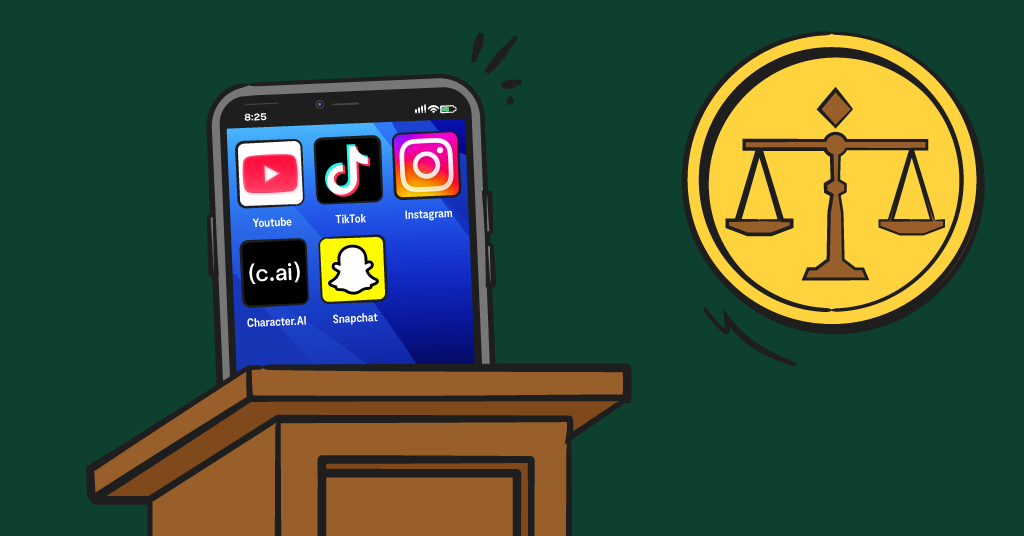
Big Tech has spent a lot of time in court this year, including a landmark settlement between Meta and dozens of states. But parents have been taking these companies to court for years, saying the apps their kids used played a part in serious harm, including addiction, mental health struggles, and in some cases, the loss of a child’s life. If you’ve ever approved an app without a second thought (and most of us have), the trail of lawsuits behind it might make you think twice. A few of these cases made national headlines, while others came and went with barely a mention.
We’re not here to rehash the legal arguments. Instead, we want to give a quick snapshot of five cases to show what families experienced, how these companies responded, and what it all means for your kids.
Snapchat and Anonymous Messaging Apps
In June 2020, 16-year-old Carson Bride of Oregon died by suicide after months of anonymous harassment. The messages came through YOLO and LMK, two apps that connected directly to Snapchat and let users send messages without revealing who they were. According to his family, some of the messages referenced things happening at school, and some were sexual. In his last days, Carson was searching online for a way to figure out who was behind them.
In May 2021, his mother filed a lawsuit against Snap and the makers of both apps, arguing they failed to enforce their own anti-bullying policies. Snap suspended YOLO and LMK from its platform the next day. Carson's parents later said they were attentive and still had no idea any of this was happening. But that’s the nature of anonymous apps. They’re built to keep activities hidden, and that often keeps them hidden from parents, too.
TikTok and the "Blackout Challenge"
Nylah Anderson was 10 years old when she died in December 2021 after attempting the "blackout challenge," a viral trend that dared kids to choke themselves until they passed out. According to her mother, Nylah didn't go looking for it. The video showed up on her For You Page, recommended by TikTok's algorithm.
A lower court initially dismissed the case, but in 2024 a federal appeals court allowed it to move forward, largely because TikTok's own recommendation system put the video in front of her. For parents, the takeaway is uncomfortable but important — kids don't have to search for dangerous content to find it. Sometimes it finds them.
Character.AI And a Teen's Relationship With a Chatbot
Sewell Setzer III, a 14-year-old from Florida, died by suicide in February 2024 after spending months talking to a Character.AI chatbot modeled after a Game of Thrones character. His mother's lawsuit described a relationship that grew emotional and sexual, and that pulled him further away from the people in his real life.
In late 2025, Character.AI announced it would end open-ended chats for users under 18, and in January 2026 the company and Google agreed to settle the case on undisclosed terms. AI companions are much newer than social media, but the risk is easy to grasp. A chatbot is always available, always agreeable, and never mentions anything to mom or dad.
Instagram, YouTube, and the First Social Media Addiction Trial
In early 2026, a young California woman known in court as K.G.M. became the first person to take social media companies to trial over addiction. She said she started using YouTube at 6 and Instagram at 9, and that years of heavy use contributed to her depression, anxiety, and body dysmorphia. Snap and TikTok settled with her before the trial began. In March, a Los Angeles jury found Meta and YouTube negligent and awarded her $6 million. Both companies disagreed with the verdict and said they would appeal.
Meta and a Settlement With The States
A few months later, in August, Meta settled a separate case brought by a coalition of state attorneys general that accused the company of designing Instagram and Facebook to hook young users. Meta agreed to pay up to roughly $18 billion over 10 years, without admitting wrongdoing.
For families, the bigger news is the list of changes that came with the deal: a default two-hour daily limit for users under 18 that only a parent can lift, hidden like counts for teens, and the option of a feed that isn't driven by the algorithm. These are welcome changes, even if they’re long overdue. And it’s worth noting that it took dozens of states going to court to make them happen.
What These Cases Mean For Your Family
It's easy to read stories like these and think, "That would never happen to my kid.” Many of these parents probably thought the same thing. But it’s less about what kids can handle and more about how these apps work. They’re built to be engaging, private, and hard to see from the outside.
The good news is that knowing the risks puts you in a much better position to talk about them. A few places to start:
- Ask about add-ons, not just apps. Tools like YOLO and LMK lived inside Snapchat, so they didn't look like separate apps on a home screen.
- Talk about viral challenges before your child sees one. Kids are more likely to scroll past a dangerous trend if they've already heard you say, "If you ever see something like this, you can always come to me."
- Bring up AI chatbots. Ask whether their friends use them and what for, and remind your child that a bot isn't a friend or a therapist, no matter how real it feels.
- Notice the shifts. Pulling away from family, guarding their phone, or staying online late at night can all be signs that something is going on.
How Bark Can Help
Conversations are the foundation, but they work best with backup. The Bark app monitors texts, email, and popular apps and social platforms for signs of cyberbullying, predators, suicidal ideation, and more, then sends you an alert so you can step in. Screen time scheduling lets you decide when devices can be used (bedtime included), and for kids just getting their first phone, the Bark Phone comes with these protections built in from day one. No tool replaces a parent who's paying attention, but the right one can help make sure you’re not kept out of the loop when your child needs you most.
Read more

Bark helps families manage and protect their children’s digital lives.