
**This blog post was updated on September 29, 2023.**
What’s the first thing that pops into your head when you hear the word “cyberbullying?” For many parents, it conjures up images of darkened rooms, computer screens, and anonymous faces. The prefix “cyber” gives it a retro, 90s-alternative feel, back when everything on the internet was new and shiny.
But for today’s kids, cyberbullying is, in reality, just bullying. This is because modern kids don’t separate online activity from real-world activity. Texting and Snapchatting friends are two ways of normal, everyday communication — not substitutes or lesser electronic versions of real-life conversations. These digital exchanges are as natural as breathing to them. In this way, cyberbullying, too, has become indistinguishable from bullying.
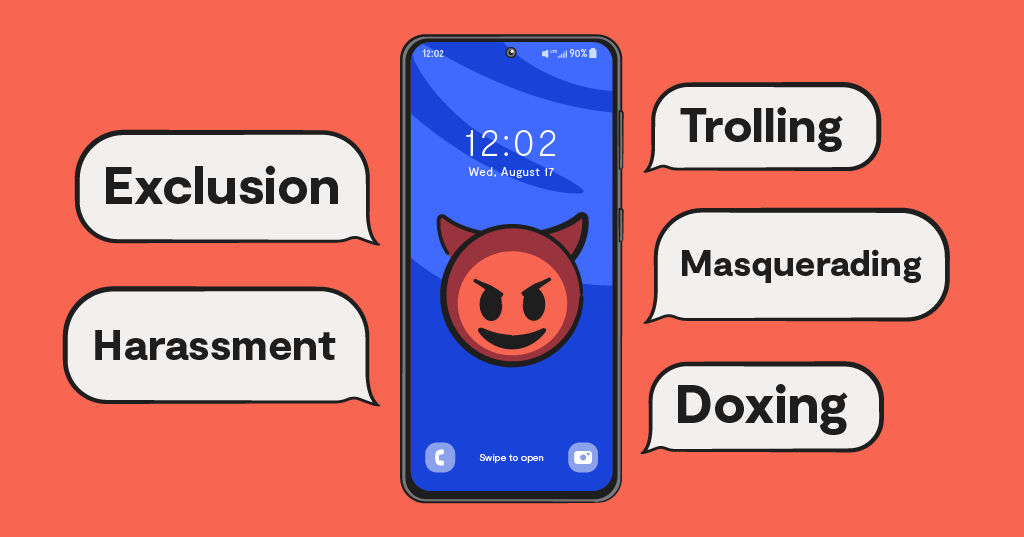
So while kids probably don’t call it “cyberbullying,” it’s helpful to explain the term to parents so they better understand the types of activities that make up bullying behavior and how they’re carried out. In all fairness, they’re not that different from the hurtful things we faced as kids in the 80s and 90s — there are just more ways (and opportunities) to carry them out now. Here are 5 very common forms of cyberbullying:
Harassment: repeatedly enacting abusive behavior against someone
Being picked on is one of the most universal forms of bullying, and it comprises countless different forms of online harassment for children. It can come in the form of aggressive or hurtful texts, emails, direct messages (DMs), and comments on social media posts. It can even come in the form of personal attacks from a bully’s own social media profiles, where the harassment can reach even more people. The onslaught can be relentless, especially when groups of kids start harassing someone together (an activity so common it’s known as “brigading”).
Many parents believe that the solution to harassment lies in blocking, but this doesn’t always offer a reprieve, as messages can be sent anew from different email accounts and social media platforms. It can be exhausting for kids to deal with harassment from countless angles, which is why it’s so serious and potentially damaging. The effects of cyberbullying can have a profound impact on children's well-being and mental health.
Masquerading: pretending to be someone you're not in order to hurt someone else
The old saying that you can never be sure who you’re talking to online is classic for a reason — you really can’t be certain. Masquerading occurs when a kid pretends to be another person online. It takes just a matter of seconds for a child to create a fake email address and a fake social media profile. Photos are easily grabbed from the internet or another profile to help round out the illusion. And while masquerading is often intended as a joke, pretending to be a stranger or a mutual friend tends to escalate quickly and can lead to trouble. By posing as someone else, a bully could gain access to a child’s innermost secrets (like who they have a crush on) and then share them with the school — resulting in potential shame and embarrassment for the child.
Exclusion: when someone is intentionally left out of a group message, event, or photo
This form of cyberbullying is akin to being picked last for a kickball team — except it can happen anywhere at any time, leaving kids reeling from its effects. There are multiple ways to exclude someone online — and many of them can be very performative and dramatic. A small-scale example is four friends in a group chat ceremoniously deciding to boot out a fifth member. On a larger scale, an entire homeroom could decide to create a group with all but one classmate and name it “Everyone in Mr. Johnson’s Class But Taylor.” As confrontations ramp up in group chat, a common threat is to block someone, the ultimate affront in a world where digital erasure equals social erasure.
Doxing: releasing someone's private information to cause them harm
Doxing occurs when someone obtains an individual’s information like their home address, social security number, or other private data and publishes it online as a way to invite harassment, fraud, or even criminal activity upon them. While kids usually don’t take it to this level, the sharing of private photos, secrets, or embarrassing information can wreak havoc on a child’s life — especially in a world where digital information can be shared instantaneously with thousands of people.
Trolling: provoking or baiting someone just to get a rise out of them
Trolling is technically a form of harassment, but it’s a very specific type of cyberbullying. A person trolls when they make inflammatory, anonymous statements online for the sole purpose of derailing an online conversation or provoking other participants in the discussion. A troll can also make an individual feel bad by constantly leaving negative comments on social media posts to hurt their feelings. Many kids experiment with trolling behavior to see what reactions they can get out of others, oftentimes by saying outrageous things they don’t even mean.
In this blog, we’ve covered some of the most common forms of cyberbullying, but note that any type of cyberbullying can greatly impact a person’s life, so it’s important to stress how important digital citizenship is with your child. By acknowledging the detrimental effects of cyberbullying and implementing proactive measures to enhance online safety, we can collaboratively create a safer digital environment for our children. Consider downloading our anti-cyberbullying contract to help keep them on the up-and-up when it comes to their online behavior. And if it’s your child who’s being cyberbullied, we've got tips for how you can help them deal with it.
Read more

Bark helps families manage and protect their children’s digital lives.