Dear Titania,
My daughter recently told me that she’s been using ChatGPT to write her English essays. I told her I don’t think that’s a good idea, and she replied that it’s not cheating because at least she’s not plagiarizing. I don’t know much about ChatGPT but this doesn’t seem right. Can you give me a primer on this platform as well as some talking points for having a productive conversation with her about it? Thanks!
Signed,
Anxious About AI
Dear Anxious About AI,
The future is now, and it’s a wild ride! ChatGPT is just the latest in what seems like a never-ending series of mind-blowing tech developments. Artificial intelligence (AI) has become extremely commonplace — think about the chatbots you encounter on homepages where you ask questions, those impressive photo filters on Instagram, and even auto-correct on your iPhone!
But as a parent, when technology starts to affect the way your child is learning and behaving in school, I’m sure your parenting spider-sense is starting to tingle, and rightfully so!
What Exactly Is ChatGPT?
ChatGPT is a website where users can ask questions and get answers from an incredibly sophisticated chatbot. The company behind ChatGPT is called OpenAI, and it works with all sorts of artificial intelligence. You may also have heard of OpenAI’s DALL-E, which takes user prompts and generates graphic designs in a matter of seconds. They’re all over social media right now.
ChatGPT: How It Works
The tech behind ChatGPT is super complex, but it’s worth explaining a little about how it works.
ChatGPT uses pattern recognition and access to unimaginable amounts of information to make decisions. Human brains do this, too, but not at the speed or volume that machines are capable of.
Let’s break down a simple example. Suppose I asked you and ChatGPT to finish this sentence: “The ice cream was ____.”
Your first guess would probably be along the lines of “delicious”, “creamy”, or “cold.” ChatGPT knows this too, based on all of the human data it's been fed — information from books, websites, articles, and more. It won’t answer “smelly”, “warm”, or “ugly”, just like you wouldn’t.
This was just a simple example, too. ChatGPT can use the same principles to answer incredibly complicated questions that take much longer to explain. But this is where it gets tricky, and where the chatbot’s limitations come into focus. We’ll get more into these issues later.
How Kids Might Use ChatGPT for School
Here are just a few examples of questions kids might ask ChatGPT:
- “Write me a 500-word essay on the theme of power in Macbeth.”
- “Solve for x: 3x + 25 = 10x”
- “Compare and contrast the French and American revolutions.”
- “What are the themes of To Kill a Mockingbird?”
- “How do I make an image tag in HTML?”
- “If train A is moving at 50 m.p.h. toward a train B that is moving at 45 m.p.h. and they start 100 miles away from each other, when will they meet?
ChatGPT can not only give correct answers to these questions, but it can also explain its reasoning in the cases of math problems — it shows its work, in other words. This makes it tricky. In the past, if you copied the answers from the back of the book, your teacher would know because you wouldn’t be able to show your steps. Not so with ChatGPT.
The Issues with AI Assistance
Can ChatGPT generate remarkably human-sounding words? Absolutely. Is it perfect? Definitely not. Here are a few of the issues it has:
It can be plain wrong
Human experiences and information don’t always conform to logic, and ChatGPT can run into problems because of this — it’s also limited to data before 2021. But because it so confidently and quickly spits out answers, kids may believe they’re always 100% true.
It can reflect human biases
ChatGPT only uses information that humans created, and it can mirror prejudices that exist in the data it’s fed with. This can include harmful positions about marginalized groups.
It will never be as creative as a real person
While ChatGPT is truly remarkable and probably the closest we’ve come to human-sounding answers in text form, it’s always…just missing something. The more you play around with it, the more you can start to see its patterns. (Hopefully, teachers will, too!)
A Tool, Not a Lifeline
At the end of the day, technology is a tool that can make our lives easier, but it’s just that — a tool, not a lifeline. Even though graphing calculators are used every day in advanced math, kids still learn how to count, add, subtract, multiply, and divide in elementary school. Once those are mastered — remember times table tests? — then calculators can be used. The same goes with ChatGPT. It can help you brainstorm, give you lots of options, and even provide a starting point for research. But it shouldn’t replace the work teachers assign to kids.
Some Conversation Starters
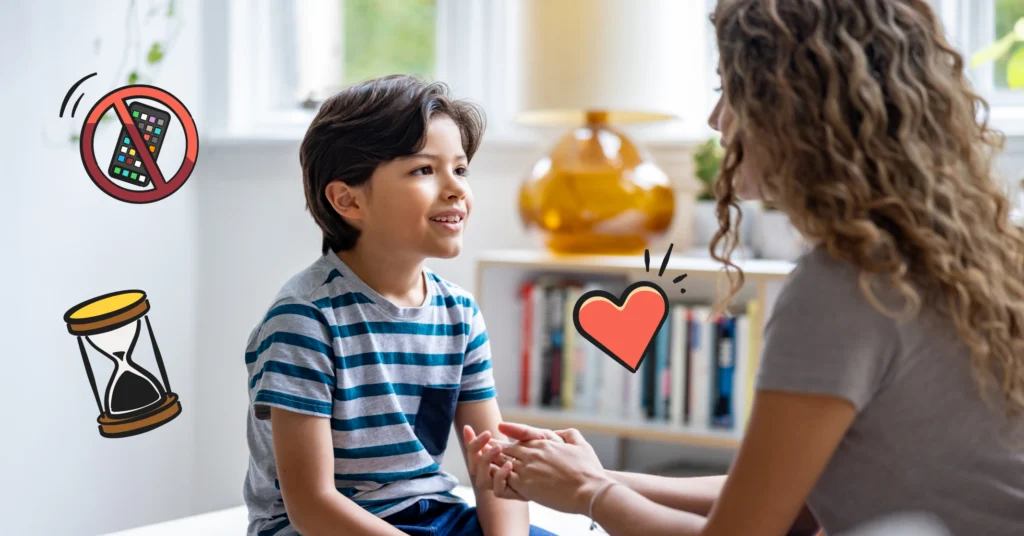
I recommend pulling up ChatGPT (you can create a free account) and sitting down with your kid to explore it together. Here are few ways to get a conversation started:
- Type in a query that has something to do with preference or personal taste, like “What is the best flavor of ice cream.” ChatGPT will return an answer that says it’s an AI model, and as such, can’t have a favorite. It will then spit out some of the most popular flavors.
- Ask your kid “Why do you think this answer is so generic?” and “Why can humans give better answers when it comes to things they love?”
- Give ChatGPT a relatively complicated question, like “Why did Britain lose the Revolutionary War?” The answer it gives will be a tight, well-structured, five-point analysis. It’s entirely correct — but it doesn’t sound like a 14-year-old wrote it.
- Ask your child “Why would a teacher think that a kid didn’t write this? Can you point to any specific parts?” Remind them that their teacher knows their performance as a student — as well as their specific style, quotes, and even usual errors.
- When you’re done asking ChatGPT questions together, ask your kid if they know how it works. This can be enlightening, because many children may understand that it gives passable responses, but not how it reaches its conclusion.
- Ask “How do you think ChatGPT comes up with all these answers? How can you tell if it’s giving you a correct answer?”
I hope this helps you make a little more sense of this new technology! We live in exciting (and overwhelming) times, and like with everything when it comes to raising kids, talking it out together will always help. Good luck!
Read more
Bark helps families manage and protect their children’s digital lives.