
Group chats are essentially the new “hallway” for today’s teens and tweens. These types of casual interactions that used to be limited to between classes or playground chats now happen anywhere, all the time, and across multiple platforms texting, Snapchat, Discord, WhatsApp, and countless others.
The trouble with group chats is that parents have a hard time monitoring and sometimes even just understanding all that goes on in a group chat ecosystem. From constantly changing slang terms to layered inside jokes and memes, it can be confusing for a kid in the thick of it all — let alone an adult on the outside looking in.
To help parents out, we’ve put together a guide to deciphering kids’ group chat norms, including both innocent dynamics and the dangers, so you can guide your kids in the digital world. Let’s jump in!
Why Group Chats Matter So Much to Kids
For the average teen, group chats aren’t just one option to communicate: They’re the go-to way to interact with friends. It carries the same value for teens as the mall did for us, or the backyard or skatepark. Group chats are both a safe space to chat about life and feelings, and the conduit for creating in-person plans with friends. Nowadays, it’s a large part of how a teen’s social life is shaped and formed.
The Psychology Behind Group Chats
Social development is crucial and always has been for all stages of childhood. Research shows that a child’s social development impacts their communication, emotional intelligence, cognition, self-esteem, and even academic success. So it’s important we look at the avenues kids are using in their social lives to ensure development is taking place healthily.
In adolescence, kids are craving more independence from their parents and taking more cues from their peers. They begin asking the all-consuming question of “Who am I?” and they begin looking outward for answers. This is why teens will seek out any opportunity to connect with others. Nowadays, this is why many parents find their kids relentlessly asking for a smartphone or social media — in their eyes, it’s not about technology, it’s about validation and acceptance.
Group Chat Bullying and the Dangers Parents Should Know
Bullying
According to the PEW Research Center, the most common form of cyberbullying is name-calling. Certainly, the ugly side of the internet (not just group chats) is the ability to say mean things behind a keyboard that we wouldn’t say in person.
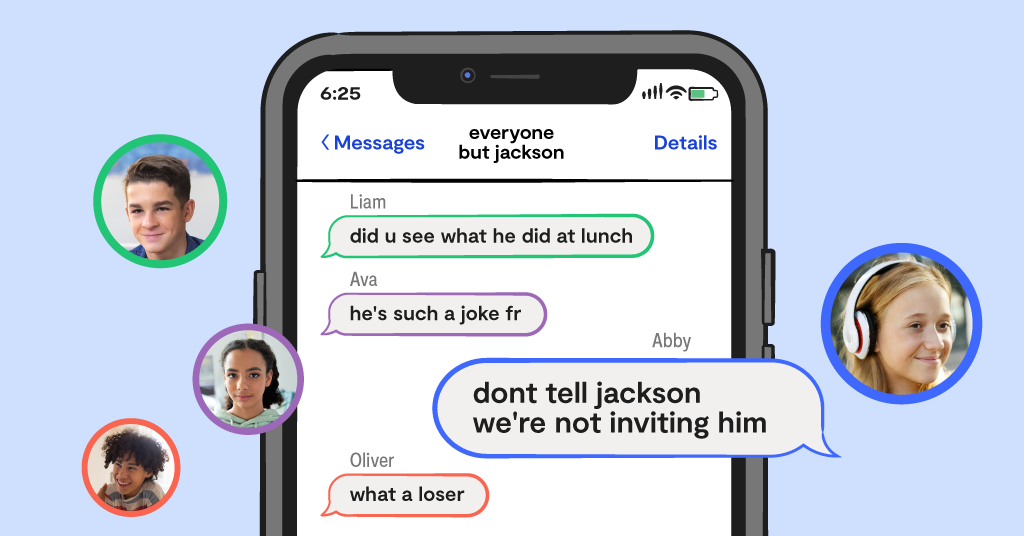
But parents should know there’s also more subtle cyberbullying that happens, and sometimes the kids who become targets are just as confused as the parents. This could be a cruel inside joke that everyone else is in on, or the coordinated act of ignoring one kid’s messages in particular.
Digital exclusion
Kids excluding one another is a tale as old as time, but in the digital world, there’s a sharper edge to it. There’s no more guessing if you’re being left out or just forgotten about — you can know right away when you’ve been removed from a group chat or blocked on social media. Or even more bluntly, when a new group chat is made for the sole purpose of adding everyone except one kid.
Spreading personal or inappropriate content
Sometimes, kids like to use the platform of a group chat to send something crazy just for the sheer shock factor. Sometimes this is a link or picture, or a video of inappropriate content (think porn or violence). Other times it’s something that exposes a peer, such as a screenshot of something they said or did. Group chats are also ground zero when nudes get spread around a school.
Norms That Aren’t Dangerous, Just Odd
It’s only fair to mention the things kids do that are not dangerous or harmful — just potentially odd to us parents. Some may require some parental coaching, but mostly it’s just kids being kids.
Spamming for fun
Has your kid ever been added to a group chat, and suddenly the device is a symphony of notifications with never-ending messages coming from just one chat (and sometimes just one specific kid)? Some kids don’t mind the spamming from their friends, but others may find it annoying. This is definitely a case-by-case situation, as there are times when a parent needs to intervene if a child is crossing boundaries through spamming, but it’s not necessarily dangerous.
The lurker friend
Some friend groups have a “group chat lurker” — a friend who is in the chat but never says anything. They get all the messages, and maybe they read them all, maybe not. Either way, it’s usually understood and accepted by everyone in the group.
Constant changing of the group chat name or picture
For whatever reason, kids get great joy from naming the group chat and choosing a picture for everyone to see. Lots of kids like to change this, constantly. Many adults hardly ever name a group chat they’re in, let alone change it multiple times. But once one kid changes it, sometimes it spurs a fury of other kids naming it and trying to be the one whose name sticks.
Group chats that spawn like Russian nesting dolls
There’s hardly ever just one group chat — if there’s one, there’s probably dozens. All of them can serve a different purpose, such as a group chat for kids going on a school trip, or a chat to plan Halloween costumes. But ultimately, kids like making tons of group chats just because they can.
Establishing Healthy Group Chat Habits
So, how do parents teach healthy group chat habits to their kids? Our advice is to start with a clear, strong foundation of expectations surrounding group chats (a lot of which applies to general healthy online habits). Then, give them a reasonable amount of space to practice it and experience it themselves.
Starting with the foundation
We suggest having open and frequent conversations with your child about healthy online habits. These lessons are rarely a “one and done” conversation, but one that is discussed multiple times as your child absorbs it over time. If your child is about to or already is participating in group chats, we highly recommend a digital contract that includes group chat etiquette expectations.
Here are some quick, top-most important things to discuss with your child and include in a tech contract:
- No spamming texts or calls to get a faster response, especially if the person has told you to stop once.
- Don’t say anything over text that you wouldn’t say in person
- No screenshots or forwarding private messages without permission.
- Don’t gang up on people or use chats to exclude others.
- No sharing inappropriate content (pictures, videos, links, GIFs, etc.)
- Remember that misunderstandings happen easily over text when you can’t hear their tone or read their facial expressions
Giving them space to practice
These open conversations and ground rules are crucial, but they can only go so far. Oftentimes, we learn the best by experiencing it ourselves. So as your child begins to navigate the group chat space, try to lean more towards coaching (i.e., asking questions about how and why they handle certain situations), rather than controlling.
If you notice in your child’s group chats clear signs of harassment or threats to hurt oneself or others, then these are obvious situations that require parental intervention. But outside of that, remember it’s okay for kids to have a healthy level of privacy and independence to work out problems themselves.
How Bark Can Help
Keeping tabs on those group chats can feel like a full-time job, so that’s where Bark comes in. Our AI-powered, industry-leading monitoring allows parents to stay in the loop on important things, without the tedious task of scanning through hundreds of messages themselves. Bark can scan your child’s texts and social media activities and alert you to concerning content — including bullying, inappropriate slang, sexual content, harassment, exclusionary language, and more.
Our content monitoring is available with the Bark app, the Bark Phone, and Bark Watch. We also offer web filtering, screen time scheduling, location tracking, and more through our entire suite of parental control products. Check out our products page to see which one is the best fit for your family, and will bring you the peace of mind you need when it comes to digital parenting.
Read more

Bark helps families manage and protect their children’s digital lives.