
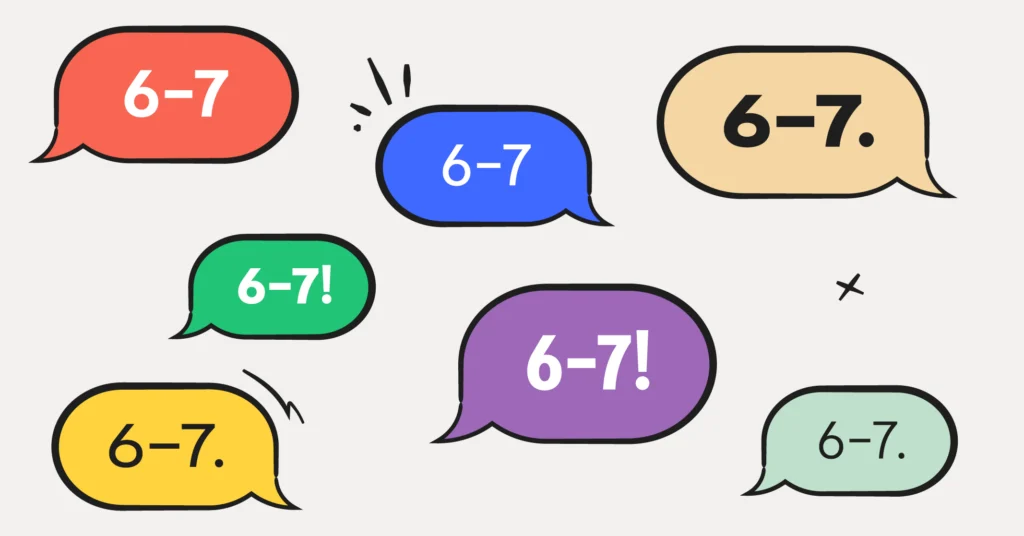
2025 will go down in history as the year that two numbers came to dominate the minds of kids, teens, and tweens – 6-7. Its popularity leapt from school hallways and bus rides to countless TikToks, brand advertisements, and even Dictionary.com’s word of the year. What accounts for this random saying’s rapid ascent to the cultural consciousness? And why is it so annoying for adults? We’ll answer all that and more – including why it’s 100% harmless and may even be helping kids connect just a little bit.
First, Where Did 6-7 Even Come From?
6-7, like many memes, has its origin in a soundbite from a song by Skrilla called “Doot Doot (6 7).” By December 2024, this clip was being used in edits of basketball player LaMelo Ball, who is 6’7 in height. The term “6-7” then spread with users on TikTok saying it while also moving their hands up and down in a see-saw motion.
While it originally probably referred to Ball’s height, it soon became divorced from any sort of real meaning. When kids say it, it’s got a specific cadence: drawn out, with stress on all three syllables. Their hands go up and down like they're weighing two invisible options. This is the 6-7 that has taken over the world the past year.
Why Is 6-7 Literally Everywhere? It’s Harmless Linguistic Slot Machine
Fast-forward to December 2025, and every child you know is saying it constantly. They don’t say it to actually mean anything, though, which is the funny and infuriating part. It’s a (very popular) inside joke that’s more like a wink. It’s not unlike “skibidi” in this sense, in that it's the utterance of it that matters, along with the knowing recognition from another person. You can take two kids of different ages and backgrounds who live across the country from each other, and if one says 6-7, the other will say it back with a smile and a nod. I can't think of another cultural touchstone that can instantly transcend location, age, social class, and gender today.
Why does 6-7 refuse to die? Because it comes up organically in daily life thanks to the numbers 6 and 7 being everywhere — textbook pages, order numbers at fast food restaurants, sports scores, dates, and a million other things. When 6-7 is mentioned, seen, scored, or heard when any kids are present, they become activated like sleeper agents. Behold the scene when a theater full of kids hears 6-7 during a Broadway play field trip.
If the 6-7 phenomenon were a more common word — like hello, for example — it would be said too often to make it special. But because it’s two numbers that are essentially guaranteed to pop up randomly, the opportunity to celebrate it comes along just often enough to make it a thing. A real, spectacular, kid-meme of a thing.
How the Rise of Brainrot Explains 6-7
Brain rot was Oxford’s word of the year in 2024, and that term refers to the term for the negative mental effects from consuming too much junk online content. Think absurd memes, silly YouTube videos, viral TikToks, and very niche video game discussions. (Check out our brain rot blog post for more of a deep dive.)
6-7, like skibidi, fanum tax, and rizz, are all examples of the constantly changing slang words that kids use today. But unlike the slang terms for years past — “all that and a bag of chips”, “tubular”, or “da bomb” — brain rot slang for Gen Alpha evolves way faster thanks to video streaming platforms and social media trends. 6-7 is just the latest phrase to take hold of America’s youth, but it’s got more staying power than some others. Why? Because of the random effect I mentioned earlier. It comes up just frequently enough to regain popularity over and over again every time someone utters it.
Need More Help Deciphering Kid Slang?
While 6-7 may seem annoying to some, it’s essentially harmless since it doesn’t mean anything or represent something secretly. But lots of other kid slang terms do have hidden meanings that parents may not be aware of. Fortunately, the team here at Bark is always on top of the latest slang words, terms, phrases, and emojis, and we’re constantly updating our slang guides for parents. These can help you understand the language your kid uses, and you can even drop a few of them over dinner conversations to see how they react.
Bark also monitors text messages, emails, and social media for dangers you might miss because of slang. Whether it’s deciphering that the plug emoji actually means a drug dealer or that the word “corn” can refer to pornography, Bark can help keep you in the know. Check out our products page to learn more about the Bark Phone, the Bark Watch, and the Bark app — they can all help you keep your kid safe online and in real life.
Read more

Bark helps families manage and protect their children’s digital lives.