
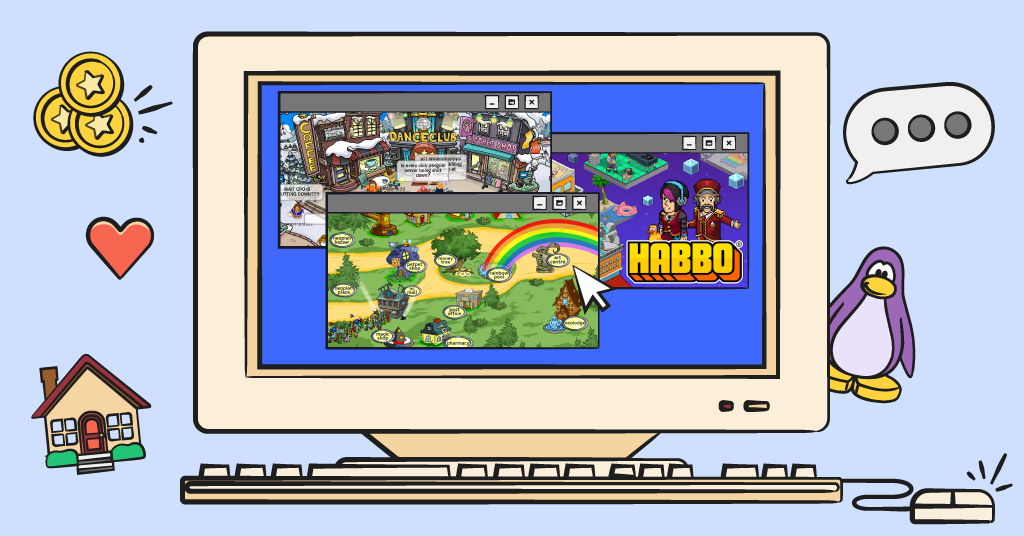
If you grew up in the late '90s or early 2000s, you remember the ritual. The shared family computer humming to life in the den. The dial-up modem's unmistakable shriek. The loading bar crawling across the screen while you waited — really waited — for your virtual world to appear. Then, your Habbo Hotel avatar strutted into a pixel-art lobby or your Neopet needed feeding. And just like that, you were somewhere else.
A growing number of parents actually remember this, and that's more useful than it might seem. You know what it's like to get lost in an online world and chat with people who could be anyone, from anywhere. That means you understand why your kid has an unexplainable draw to Roblox. It also means you already know the internet has never been without its dangers. Not even back then.
The Beginnings of Online Worlds
Let's take a moment to jog your memory of some old online stomping grounds.
Habbo Hotel (2000–present) was the virtual hangout for older millennials who thought they were too cool for the kiddie stuff. You had a pixel-art avatar, a hotel room you could furnish with "furni" that carried genuine social currency, and a lobby full of strangers to chat with. At its peak, Habbo had tens of millions of users worldwide. It felt edgy in a fun way, with more freedom, fewer rules, and more personality than anything else online at the time.
IMVU (2004–present) took the avatar concept further. You could design your character in meticulous detail, decorate a virtual room, and chat with anyone. IMVU leaned heavily into self-expression and social connection, which made it genuinely compelling for teenagers figuring out who they were. It also had virtually no guardrails on who could talk to whom, which made it a very different kind of place depending on which corner you wandered into.
YoWorld (then YoVille, launched 2008) lived inside Facebook, which tells you something about the era. You had an avatar, an apartment, a social feed full of your actual friends, and of course, strangers. The Facebook integration made it feel a little more legitimate, but functionally, it was the same kind of open chat room as the others.
Neopets (1999–still technically alive) was the oldest and most established of the bunch. It was digital pets, a whole economy built on "Neopoints," and a Haunted Woods that was genuinely spooky to a nine-year-old. An entire generation accidentally learned basic economics from the Neopets marketplace.
And for the younger millennials and elder Gen Z kids: you probably remember Club Penguin and Webkinz. Whereas Habbo Hotel was targeted for teens and young adults, these were actually intended for younger kids and were generally more wholesome by design.
The Danger Behind the Nostalgia
What most of us didn't realize about these platforms is that they had adults, and lots of them. Not just the occasional college student, but adults with bad intentions, operating in spaces designed for kids and teens, with very little stopping them. These were open social platforms with minimal moderation, which meant they were genuinely fun for most users and genuinely dangerous for some.
Habbo Hotel is probably the starkest example. A 2012 Channel 4 investigation found predators using the platform to contact minors, running virtual scams, and participating in explicit roleplay in corners of the hotel most kids never wandered into. Today, the news is filled with headline after headline of online predator investigations into some of the most popular apps on the market.
What Made Them Different From Today
Here's what was different about the early internet, and it matters for context.
The technology itself had a higher barrier for entry. Dial-up connections, shared family computers in common rooms, loading times that could stretch for minutes — all of this meant that getting online was an event, not a constant state. You logged on for an hour after school, then you went outside. The idea of being perpetually connected didn't exist yet.
These platforms were also largely isolated from one another. Your Habbo Hotel friends mostly stayed on Habbo Hotel. There was no algorithm pushing increasingly extreme content your way. You couldn't doomscroll. When bad things happened, they happened in specific corners of specific platforms. The platforms weren’t optimized to keep you engaged.
Predatory behavior existed, but it was less coordinated. Bad actors in 2004 weren't using the same playbooks, the same grooming scripts, or the same off-platform migration tactics that they use today. And most kids from this early internet era, frankly, got lucky. The danger was real, it’s just that the infrastructure around it was less organized.
Enter Roblox: Familiar Fun, Much Higher Stakes
Roblox is the level up to all of these platforms. It has the virtual hangout energy of IMVU, the user-generated creativity of a digital playground, the in-platform economy of Neopets, and the social architecture of Habbo Hotel, all rolled into one. For kids today, it has everything they could want in an online world.
The scale alone is staggering. At its peak, Habbo Hotel had 316 million registered accounts total. Roblox? It has over 380 million active users on a monthly basis. The modern version isn't just bigger, it's a different category entirely.
What's also different: Roblox is built for near-constant social interaction, including with strangers. The content is user-generated across millions of experiences, which means quality and safety vary wildly. And when in-game chat gets restricted, kids often migrate off-platform to Discord, Snapchat, or other apps. This is a pattern worth knowing about if you have a Roblox-obsessed kid at home.
None of that means Roblox is always a bad place. Kids experience real social connection there. They get to build creative things. The impulse driving them to it is the exact same impulse that drove you to Habbo Hotel. It’s natural, normal childhood fun. But the stakes are higher, the scale is massive, and the bad actors have gotten a lot more sophisticated since 2005. That's where a little backup helps.
You Already Know What This Feels Like — Use That
As a millennial parent, you have firsthand knowledge that previous generations simply didn't have: you know what it feels like to be a kid in a virtual world. You know how real those friendships felt. You know how easy it was to lose track of time. When they're upset about something that happened in a game, you know that's real emotion. And when something feels a little wrong, you know what that's like too.
The internet has always had dangers. The difference is that now, parents have better tools to navigate them, which is where Bark comes in. Bark monitors your child's online activity (including Roblox) and sends you an alert if something concerning comes up, such as predatory contact, bullying, or conversations that warrant a conversation. You don't have to understand every corner of Roblox to stay informed. Check out Bark’s suite of online safety products to find out which one is the best fit for your family.
Read more

Bark helps families manage and protect their children’s digital lives.