
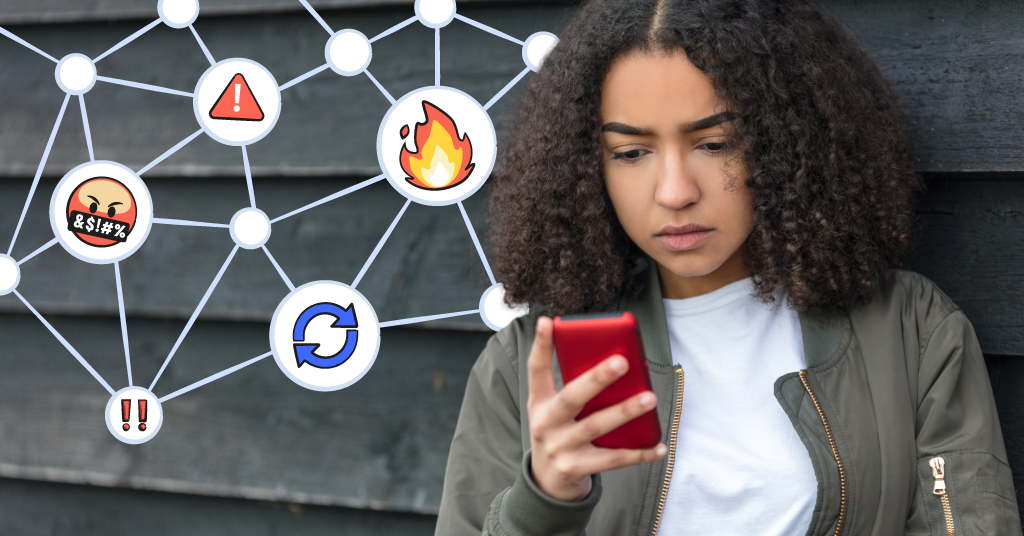
There was a time when a scroll through social media was made up of vacation updates from your parents, photos of your friend’s favorite bagel, and maybe even fashion tips from your favorite influencer. But that time is long gone. What kids see on social media today is far different from what your feed looked like as a teen, or even what your feed looks like today.
As feeds become increasingly monetized, platforms like TikTok and Instagram are fine-tuning their algorithms to prioritize content that sparks a reaction and keeps users watching. Like it or not, you’re now far more likely to come across a divisive video with a “hot take” than photos of your neighbor’s new gardening project. And these small algorithm changes? They can lead to seismic shifts in your teen’s online world and attitude. Below, we explore what today’s social media landscape looks like, how it’s affecting kids, and what you can do as a parent to help them stop the scroll and stay grounded.
What Is Rage Bait and Why It Works
Oxford’s Word of the Year for 2025, the dictionary defines rage bait as “online content deliberately designed to elicit anger or outrage by being frustrating, provocative, or offensive, typically posted in order to increase traffic to or engagement with a particular web page or social media content”. You’ve likely encountered it at some point — a mom sharing a controversial take on spanking or a creator insisting that “kids today are just lazy”— but as social unrest has taken center stage and the middle ground has faded, both rage-bait content and the term itself have more than tripled in usage over the past year.
Rage bait’s intentionally divisive strategy works because it taps into our innate “negativity bias.” Humans react more strongly to negative information, with negative events eliciting more action than positive ones. Bold, context-free statements from creators provoke immediate anger and the urge to weigh in or “prove them wrong” in the comments. This engagement, positive or negative, signals to the algorithm that the content is worth pushing to a wider audience. The result: greater reach of negative content online and, ultimately, more money for the content creator.
The Rise of Reposts and Recycled Content
It’s no coincidence that TikTok makes it frictionless to respond to a video or that Instagram is actively rolling out its repost feature. Both platforms are betting on a simple behavior: people want an easy way to participate in the conversation. Instead of just liking a post, users can remix it, stitch it, duet it, or reshare it to their own audience in seconds, sending the same clips ricocheting across feeds and platforms within hours.
A video that began as satire, commentary, or unintentional misinformation can reach teens as a standalone sound bite shaped more by reactions than by its original intent. Now, the proliferation of AI-generated content is speeding up this process. It allows creators to mass-produce videos, reuse the same formats, and push out multiple versions of the same idea in minutes. And because the algorithm prioritizes engagement, it continues to serve audiences more of what they just watched, whether the content is original, remixed, or fully AI-made.
How Algorithms Create Traps
Today’s social platforms don’t just track what you like. They measure how long you watch, whether you rewatch, and what you open next. Those signals reshape a feed fast. In a University of Washington analysis of 9.2 million TikTok recommendations, researchers found that within the first 1,000 videos a new user sees, up to half are already based on predicted interests rather than who they follow. Much of that prediction comes down largely to watch time. YouTube has publicly stated it optimizes for “expected watch time,” and short-form video platforms use similar engagement signals to decide what to push next. One lingering view or full watch can quickly turn into a steady stream of related content.
What makes these patterns hard to break is how quickly the system reinforces itself. In a Wall Street Journal investigation, automated TikTok accounts that paused on a specific topic were sent deep into the same content “rabbit hole” in under 30 minutes. Even when users try to scroll past something, the algorithm is still learning from what previously held their attention and serving close variations of it. Over time, that creates a feed that is less a reflection of what someone chooses and more a prediction of what will keep them watching.
How This Content Affects Kids
Algorithm traps and the content they regularly resurface don’t stay on the screen. Rage bait, reposts, and AI-generated content affect how kids engage online and with the world around them.
- Emotional fatigue from constant intensity. When every scroll delivers something dramatic, the brain adapts by tuning some of it out. The American Psychological Association warns that repeated exposure to high-arousal social content can contribute to emotional numbing in adolescents.
- Less creativity and fewer original perspectives. Trend-driven feeds reward copying what’s already popular. Instead of sharing new ideas, kids are often nudged to use the same sounds, formats, and takes as everyone else.
- A distorted sense of what’s normal. When teens get more content from algorithmic recommendations than from accounts they've chosen to follow, they’re more likely to get stuck in an unrealistic echo chamber. That system naturally surfaces the most attention-grabbing posts, so extreme opinions, luxury lifestyles, or highly edited appearances start to look typical.
- Less confidence in what to trust. Reposts and AI-generated clips often travel without their original context, which makes authenticity harder to judge. Researchers at Stanford’s Internet Observatory note that this environment increases uncertainty about what’s real, especially for younger users still building digital literacy. Over time, this can even make kids less confident in their own judgment.
Teaching Kids to Recognize Manipulative Content
You don’t need to be a tech expert to talk to your kids about what’s going on in their feed. Simple, ongoing conversations can help them understand what they’re seeing online and build healthy habits.
- Teach them to spot emotionally loaded framing. Help kids notice when a post is trying to make them feel angry, shocked, or defensive on purpose. Phrases like “No one is talking about this,” or overly confident hot takes are often designed to trigger a reaction, not inform.
- Build media-literacy habits. Encourage them to pause and ask questions like: Does this make sense? Does it look real? Who made this and why? You can also encourage them to use this checklist to spot and recognize deep fakes.
- Encourage breaks and more intentional viewing. Normalize logging off, scrolling with a purpose, and choosing what to watch instead of letting the algorithm decide. Even short resets help disrupt the automatic loop.
How Bark Can Help
As today’s feeds move faster and feel harder to decode, parents don’t have to keep up on their own. Bark helps you stay informed about what’s happening in your child’s digital world by alerting you to potential concerns and giving you the context you need to start meaningful conversations. Explore Bark’s tools to find what works best for your family.
Read more
Bark helps families manage and protect their children’s digital lives.